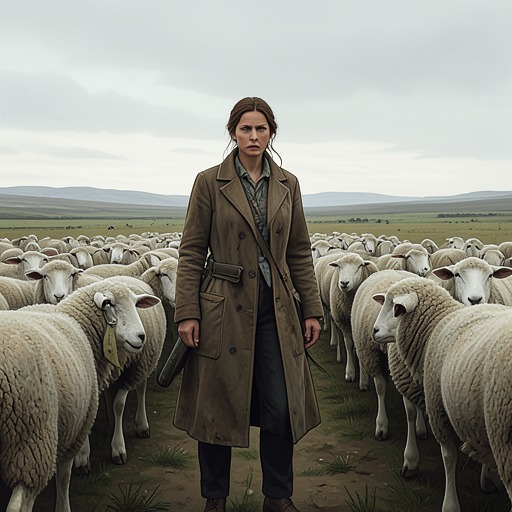
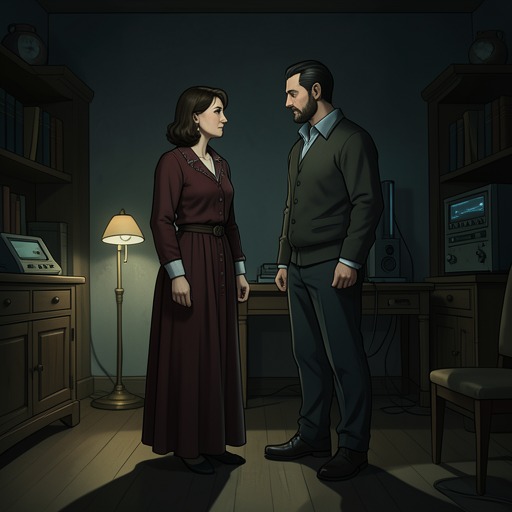
Rebecca questions Beth about George’s life and death
Three Bags FullRebecca’s interview with Beth is both an inquiry into George Glenn’s death and an encounter with the damage left by his life. The sheep know, by scent, that Rebecca is George’s daughter; Beth’s recollections add the picture of a man preparing to leave Glennkill, while her suspicions about Ham point toward another possible source of danger. Yet the scene’s sharpest turn is not an accusation. Rebecca comes asking for what Beth understands as forgiveness, and the investigation becomes inseparable from the estrangement it is trying to understand.
Identity and Context
The inquiry begins in the wake of George’s death. His body had been found in the grass beside the hay barn, with a spade protruding from him; the sheep gathered to consider what had happened while trying to keep panic at bay. For Rebecca, however, the case is not merely a mystery about a dead shepherd. The sheep have recognized the family scent in her sweat, skin, and hair, and concluded that she is George’s daughter. They are surprised that George had a child, and unsure what that connection means to humans, for whom parentage may carry a weight it does not have in their own flock.
That uncertainty gives Rebecca’s questions a double force. She is investigating a man whose life she did not fully know, while the sheep observe that the relationship itself may explain why knowledge was missing. Their view remains partial: they can identify a family resemblance through scent, but cannot tell what Rebecca and George meant to each other or why they were divided. The investigation therefore moves between evidence about George’s public life and the private history neither the sheep nor Rebecca can initially see in full.
Beth’s Recollections and Suspicions
Beth receives Rebecca with agitation. She objects that Rebecca has come to her despite knowing so little about George, and demands to know what she wants. Rebecca answers that Beth would probably call it forgiveness. The reply leaves Beth thunderstruck: in a single exchange, the interview shifts from fact-finding to the unresolved history between the two women and George. Rebecca’s quietness does not settle what happened between them, but it makes clear that her presence is not driven by curiosity alone.
When Rebecca asks why George had been away so often, Beth says she does not know what he was doing. She remembers him dressing well in a suit and white shirt, looking ten years younger and like a gentleman when he went away. People talked, but Beth says she did not believe the gossip; she thought he went to Dublin, to offices and banks, and wanted to get away from Glennkill. When Rebecca asks whether someone did not want him to leave, Beth nods. Her account suggests that departure mattered to someone, but does not identify who or establish why George was prevented from going.
Beth also directs Rebecca toward Ham. She describes his piety as a performance and says people are afraid of him, while he seems afraid himself. His butcher’s shop has a CCTV camera, installed long before such equipment was familiar locally; Beth finds it suspicious that a butcher would have one when even the bank did not. She recalls confronting him about it at the church Christmas collection, where he became red with anger and embarrassment. These are Beth’s observations and suspicions, not proof of Ham’s involvement. They nevertheless widen Rebecca’s inquiry beyond the family conflict and toward the secrets that may be concealed in the village.
The Straw Figure and George’s Absences
The conversation also turns to a small bundle of straw on Beth’s table. It has been tied into the shape of a person, with a twig pushed through its body. Beth offers the possibility that it was a silly trick by children. She remembers that they called George the Goblin King behind his back and feared him, a memory that places his isolation in the local imagination without explaining who made the figure or what it was intended to signify. The object resembles a crude, pointed effigy, but Beth does not claim to know its maker or meaning.
Her description of George’s absences complicates the image of a settled shepherd who simply belonged to the pasture. He dressed for those trips, went away repeatedly, and apparently wanted to escape Glennkill. Elsewhere, local men speculate that George’s land and a possible drug trade lay behind his conflicts with them: they recall his hostility toward tourists and his refusal to sell, and suggest that boats brought goods ashore by night. That account is allegation, not confirmation, and it sits uneasily beside Beth’s belief that George went to Dublin on personal business. The investigation accumulates competing explanations without allowing any one of them to stand as the answer.
The Personal Meaning of the Inquiry
A later story Rebecca tells the sheep casts the estrangement between herself and George in a clearer, more painful light. In her tale, a little girl has a secret father as well as an unsecret one. She and the secret father are fond of each other, but after a quarrel she tries to make him angry, and they do not speak for a long time. A letter eventually tells her that he plans to travel to Europe and wants to see her first. She hides her joy and keeps him waiting; he waits himself to death. The story does not name its characters, but its details connect Rebecca’s knowledge of a delayed meeting with the father she has lost.
That later telling gives emotional shape to the earlier request for forgiveness. Rebecca’s investigation is not resolved by Beth’s testimony: it produces clues about George’s movements, possible pressure on him to stay, and Ham’s suspicious behavior, while leaving essential questions open. Its decisive revelation is instead intimate. George was Rebecca’s father, and their separation was bound up with a missed chance to meet before his death. The inquiry therefore makes the case’s central absence twofold: the unexplained circumstances of George’s death and the time father and daughter did not recover.